Automatic Case Sealers for Heavy Mixed-Size Boxes: An ROI Guide
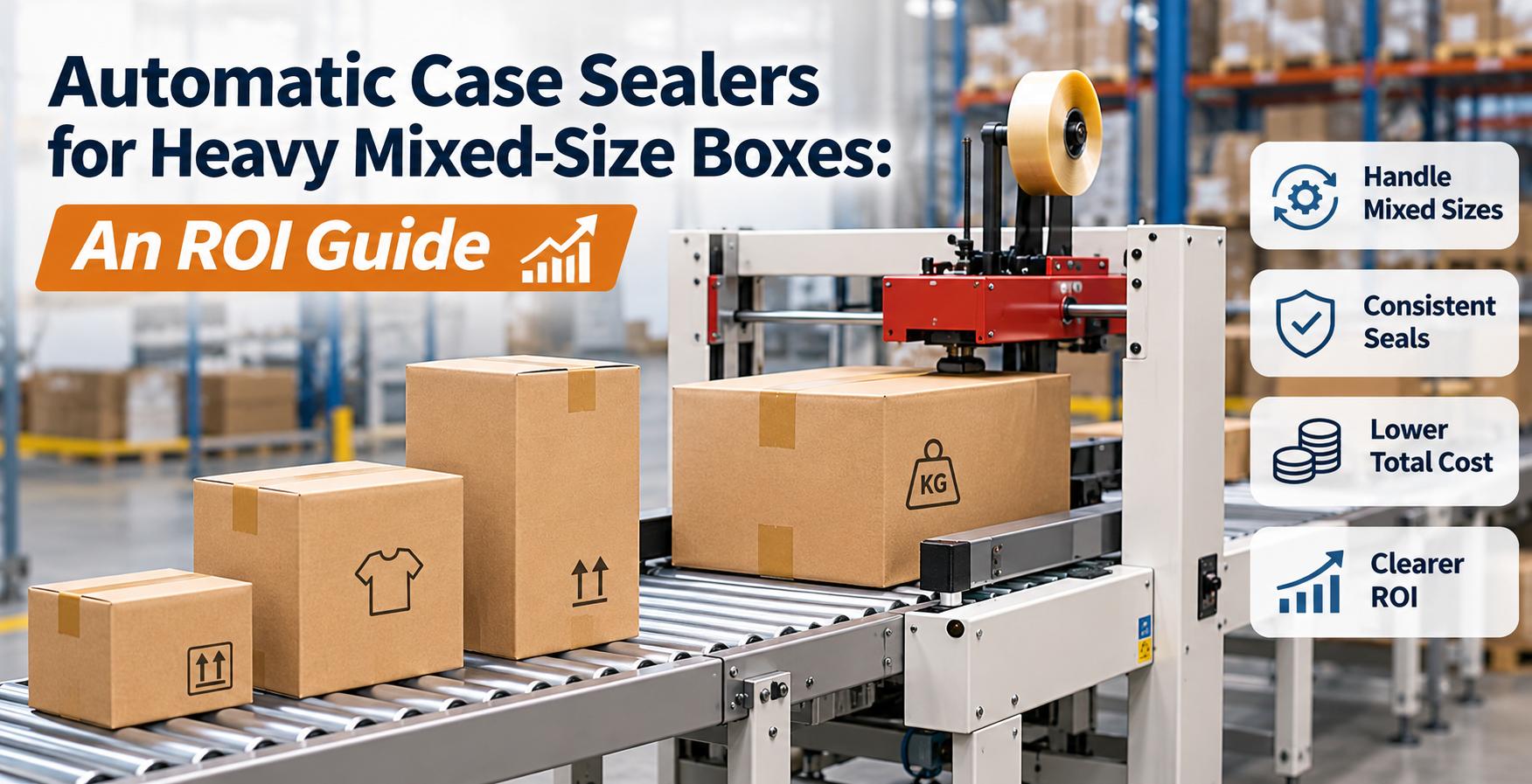
If every carton on your line were the same size, choosing a case sealer would be simple. You would set the machine once, and it would run all day. Real packing lines are rarely that tidy. Most e-commerce and fulfilment operations ship a mix: small mailer cartons in the morning, tall boxes for apparel at midday, and heavy, over-packed cartons at peak. That mix is where the money leaks out — not in the price of the machine, but in changeovers, inconsistent seals, rework, and damage claims. This guide walks through how to judge whether an automatic case sealer pays for a mixed-size line, and which type fits.
On this page
Table of Contents
On this page
Table of Contents
Where the Money Actually Goes
Start with the costs you already pay. Hand taping looks cheap because the tape gun is cheap. The real cost sits in the minutes around it. Every time the box size changes, someone stops, adjusts, and restarts. Tape applied by hand varies from person to person: too little tape and the seal fails in transit; too much and you are paying for tape that adds nothing. A seal that fails means a re-pack, a replacement shipment, or a customer who does not come back.
Mixed-size lines make all of this worse. A line that runs ten sizes a day pays the changeover cost ten times. A line that runs one size pays it once. So the first step in any return-on-investment calculation is not the machine price. It is an honest count of your own changeovers, re-tapes, and damage incidents over a normal week. If you do not measure those, any payback figure is a guess.
Semi-Automatic or Fully Automatic?
Case sealers fall into two broad types, and the right choice depends mostly on daily volume and how much the box size varies.
Semi-Automatic Case Sealers
A semi-automatic sealer still needs an operator to feed each carton, but it applies the tape itself, top and bottom, with the same pressure and placement every time. It is the right fit for lines sealing roughly 200 to 1,500 cartons a day.
Our own semi-automatic model, the KN-1717U, needs neither a compressed-air supply nor a water supply, which matters on a line where adding utilities would itself be a project. For lines that regularly handle large or heavy cartons, the KN-2626U covers boxes up to 660 by 660 millimetres and up to 60 kilograms.
Fully Automatic Case Sealers
A fully automatic sealer takes the carton from a conveyor, folds the flaps, and seals without an operator touching each box. It fits lines above roughly 1,500 cartons a day, or lines where the mix itself is the problem.
Our fully automatic model, the KN-1721R, runs in a dual mode so it can handle mixed sizes without a full reset between them. For sites that need a complete packing line, the CE1720U-S case erector paired with the TS-1720U sealer runs as one combination line.
When a Hand Dispenser Is Enough
Below about 200 cartons a day, a sealer is usually hard to justify, and a good hand dispenser — such as our KN-266 or KN-366Hi — is the better spend. The point is that the volume band, not the catalogue price, decides the type.
The Tape Matters as Much as the Machine
A sealer can only be as good as the tape it applies, and mixed-size lines usually ship mixed weights too. We size water-activated tape by carton weight: up to 10 lb, 10 to 35 lb, 35 to 55 lb, 55 to 90 lb, and above 90 lb each call for a different grade. A light tape on a heavy carton will fail no matter how good the machine is; a heavy tape on a light carton is money thrown away.
Water-Activated Tape vs. Self-Adhesive Kraft Tape
There is also a choice between water-activated tape and self-adhesive kraft tape.
Water-activated tape uses a starch-based adhesive that bonds with the fibres of the carton itself. The seal is tamper-evident — once opened, it cannot be resealed invisibly — and the sealed box can go straight into the paper recycling stream with the tape still on it. It needs water and a dispenser to activate.
Self-adhesive kraft tape uses a hot-melt adhesive and sticks on contact, so it is the right choice where there is no water station, for example at a temporary packing bench or in the field. Its shelf life is about one year, against about two years for water-activated tape.
For heavy cartons, reinforced grades carry the load: our self-adhesive reinforced JLN-28160 is rated at 45 lbs/in, and our heaviest water-activated grades, JLN-37120 and JLN-37120R, cover cartons above 90 lb. Match the tape to the carton weight and to the station, and the sealer will do the rest.
A Simple ROI Worksheet
You do not need a consultant to judge payback. Take one normal week and write down five numbers from your own line:
- The minutes spent on changeovers.
- The minutes spent re-taping failed seals.
- The number of damage or return claims tied to sealing.
- The tape you use per hundred cartons.
- The labour minutes per carton.
Then price a sealer the same way you would price any equipment: the machine, installation, any utilities it needs, and tape.
The monthly saving is the difference between what those five numbers cost you now and what they would cost with consistent machine sealing. Divide the machine cost by that monthly saving and you have the payback period in months. If the saving is small because your volume is low or your sizes rarely change, the honest answer is to stay with hand dispensers for now. If changeovers and rework dominate your week, the payback is usually measured in months, not years — but run it with your numbers, not ours.
Test the Machine Before You Buy
One caution: trial the machine with your own cartons before you buy. Tape performance figures are laboratory averages, and your board grade, humidity, and dust load will differ. A short trial with the sizes you actually ship tells you more than any brochure.
During the trial, check three things:
- That the seal holds on your smallest and your largest carton alike.
- That tape placement stays centred when the size changes.
- That the seal survives a drop from your normal handling height.
If any of those fail, change the tape grade or the machine setting before you sign — not after the machine is on your floor.
A Short Checklist Before You Buy
- Measure the smallest and largest cartons you ship, and the heaviest.
- Count how many size changes happen on a normal day.
- Check what utilities each candidate machine needs — air, water, or neither.
- Confirm the tape grades that match your carton weights.
- Ask for a trial on your own line with your own cartons.
If a supplier cannot do that, the machine is not ready for your mix.
Mixed-size lines do not need the most expensive sealer. They need the sealer whose changeover cost fits the number of sizes they run, and tape matched to the weight they ship. Get those two decisions right, and the return on investment takes care of itself.
Comments
0 comments
No comments yet. Be the first to comment.
Related Articles
Oct 7, 2026
9 Myths About POS Software That Keep Kirana Owners Stuck on Paper
Ask ten kirana owners why they haven’t switched to a POS, and you’ll hear the same excuses on repeat. Some are fair. Most are outdated. Let’s go through them one by one. Myth 1: “POS software is only for big supermarkets.” The truth: Modern billing software is built for shops of every size, including single-counter…