Why to Outsource Medical Billing Services?
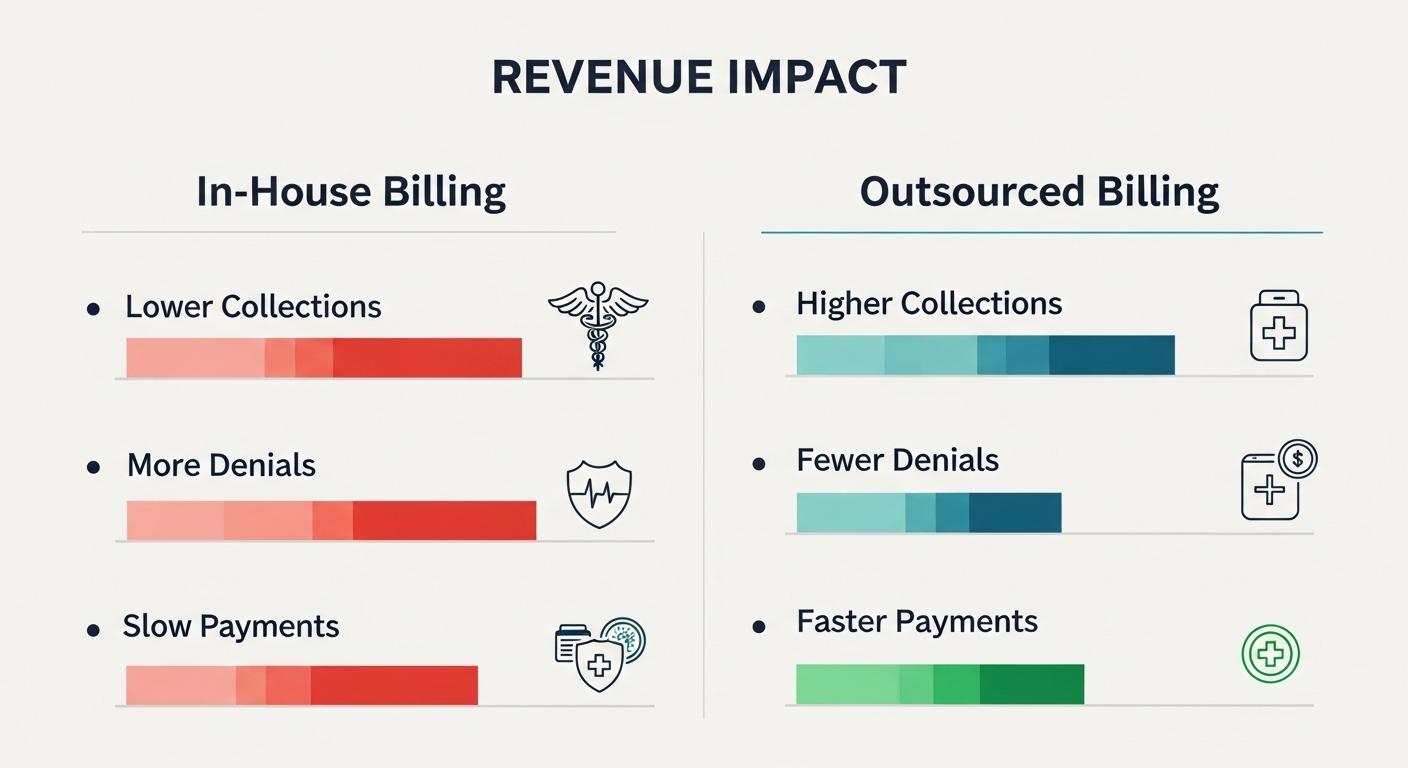
Managing a medical practice today involves much more than delivering quality patient care. Behind every successful practice is a complex administrative system that keeps operations running smoothly. One of the most demanding parts of this system is medical billing. From coding and claim submission to denial management and compliance, billing requires accuracy, time, and deep expertise. Even small errors can lead to delayed payments, claim denials, and revenue loss.
On this page
Table of Contents
On this page
Table of Contents
Because of these challenges, many healthcare providers are now choosing to outsource medical billing services. Outsourcing is no longer just a cost-cutting tactic; it has become a strategic decision that helps practices improve revenue cycle management, reduce administrative burden, and maintain compliance. When done right, outsourcing can transform the financial health of a medical practice.
This guide explains why outsourcing medical billing services is a smart move for modern healthcare providers and how it can benefit practices of all sizes.
Understanding Medical Billing Services
Medical billing is the process of translating healthcare services into financial claims and ensuring providers are reimbursed by insurance companies and patients. It connects clinical services with revenue generation. The process involves multiple steps, including coding diagnoses and procedures, verifying insurance eligibility, submitting claims, posting payments, and following up on unpaid claims.
Medical billing also requires knowledge of CPT, ICD-10, and HCPCS codes, payer policies, and changing healthcare regulations. Because insurance requirements and coding rules frequently change, billing is not a one-time task but an ongoing responsibility that demands constant updates and monitoring.
When billing is not handled properly, practices may experience delayed reimbursements, increased denials, compliance risks, and patient dissatisfaction. This is why many providers turn to specialized medical billing companies for support.
Increased Revenue and Faster Reimbursements
One of the main reasons practices outsource medical billing is to improve revenue. Medical billing companies focus entirely on revenue cycle management. Their teams are trained to submit clean claims, which significantly increases first-pass acceptance rates. Clean claims reduce the chances of rejection and speed up reimbursements.
Outsourced billing teams also track claims aggressively. They follow up with payers, correct errors quickly, and resubmit denied claims. This proactive approach prevents revenue from slipping through the cracks. Many practices report noticeable revenue improvement after outsourcing because fewer claims are lost or underpaid.
A well-managed billing process directly impacts cash flow. When reimbursements arrive faster and more consistently, practices can operate with greater financial stability.
More Time to Focus on Patient Care
Healthcare providers enter the medical field to care for patients, not to handle paperwork. However, in-house billing often consumes a significant amount of staff time. Tasks like insurance calls, denial appeals, coding corrections, and payment tracking can overwhelm administrative teams.
Outsourcing medical billing removes much of this workload. When billing responsibilities shift to a dedicated team, in-house staff can focus on scheduling, patient communication, and clinical support. Physicians can devote more attention to treatment and patient outcomes instead of administrative concerns.
Improved focus on patient care often leads to higher patient satisfaction, better reviews, and stronger patient retention. In this way, outsourcing indirectly supports practice growth.
Cost Efficiency and Reduced Overhead
Maintaining an in-house billing department can be expensive. Practices must cover salaries, training, benefits, software subscriptions, office space, and equipment. They also need to manage staff turnover and ongoing education for coding updates.
Outsourcing converts these fixed costs into predictable service fees. Instead of managing a full billing department, practices pay for professional services that are often more efficient. There is no need to invest in expensive billing software or continuous staff training.
For small and mid-sized practices, this cost efficiency can make a significant difference. Even larger practices find outsourcing attractive because it streamlines operations and reduces administrative strain.
Access to Certified Billing Experts
Medical billing companies employ trained and certified professionals who specialize in coding, compliance, and payer rules. These experts stay updated on industry changes, including coding updates, regulatory requirements, and insurance policy modifications.
Having access to experienced billers reduces errors and improves claim accuracy. It also ensures that claims meet payer guidelines before submission. This expertise is difficult to maintain with a small in-house team, especially when rules frequently change.
Outsourcing provides a full team of specialists without the burden of recruitment, training, and retention.
Compliance and Data Security
Healthcare billing must comply with strict regulations, including HIPAA. Data breaches or non-compliance can lead to legal issues and financial penalties. Reputable medical billing companies prioritize data security and compliance. They use secure systems, encrypted communications, and access controls to protect patient information.
They also maintain audit trails and standardized processes that support regulatory compliance. For many practices, this level of security is hard to maintain internally without significant investment.
Outsourcing to a trusted partner reduces risk and provides peace of mind.
Advanced Technology and Analytics
Scalability for Growing Practices
As practices grow, billing becomes more complex. More patients, more providers, and more services mean more claims to manage. Scaling an in-house billing department requires hiring and training additional staff, which can be time-consuming and costly.
Outsourced billing services are designed to scale. They can handle higher volumes without disrupting workflow. Whether a practice adds new providers or opens new locations, the billing company can adjust accordingly.
This flexibility supports long-term growth.
Reduced Claim Denials and AR Issues
Claim denials are one of the biggest revenue challenges in healthcare. Denied claims require rework, follow-ups, and appeals. Without proper management, they can turn into lost revenue.
Outsourced billing teams actively manage denials. They analyze denial reasons, correct issues, and resubmit claims promptly. They also work on aging accounts receivable to recover outstanding payments.
This consistent follow-up helps maintain a healthy revenue cycle.
Who Benefits Most from Outsourcing?
Outsourcing medical billing is beneficial for many types of practices, including:
- Small and mid-sized clinics
- New practices with limited staff
- Specialty practices with complex coding
- Multi-provider practices with high claim volumes
- Practices experiencing frequent denials
- Providers seeking predictable revenue
Even well-established practices choose outsourcing to improve efficiency and profitability.
Choosing the Right Medical Billing Partner
Selecting the right billing company is crucial. Practices should look for providers with certified coders, transparent pricing, and strong client feedback. Specialty experience is also important because different fields have unique billing requirements.
Reliable billing partners offer clear reporting, denial management support, and strong communication. HIPAA compliance and data security measures should always be verified.
A good billing partner acts as an extension of the practice, not just a vendor.
Comments
0 comments
No comments yet. Be the first to comment.
Related Articles

Mar 5, 2026
Why Phlebotomy Training Is a Great Career Choice in Healthcare?
Healthcare is one of the most respected and stable career sectors in the world. Many people are now choosing clinical, skill-based professions for job security and personal satisfaction. If you enjoy working with people and want a practical healthcare role, phlebotomy could be an excellent career path. Phlebotomy training provides essential clinical skills for blood […]

Feb 16, 2026
Spark Clear Aligners vs. The Rest: Why Dubai Patients Are Switching
Spark Clear Aligners feature a proprietary TruGEN(TM) polymer and manufacturing process that delays yellowing and staining for longer than some other brands, a practical benefit in Perth and equally desired in Dubai, where hot drinks are popular. Further, peer clinical studies of Spark and Invisalign confirm that results are at least comparable for technical factors […]